| (To be checked against delivered speech) |
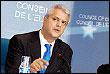 |
| Speech by Adrian NASTASE, Prime Minister of Romania | |
|
[Abstract of the Verbatim report of the Assembly] |
|
|
30.09.2003 |
Mr NASTASE (Prime Minister of Romania) said that it was a pleasure to be back in the Hemicycle. First and foremost, he wanted to thank the President, his colleagues and members for the invitation to address the Parliamentary Assembly.
In January 2001, he had addressed the Council of Europe as the newly elected Prime Minister of Romania. At that time he had paid tribute to the Council of Europe for its services to democracy and the rule of law. In this address he wished to take the opportunity to share with the Council of Europe his views on the past and the present in Romania.
On 7 October, Romania would celebrate the tenth anniversary of its accession to the Council of Europe. During those ten years the Council of Europe had changed its image, with a significant increase in its membership.
The Council of Europe provided a pan-European call to protect democracy, human rights and justice. On many occasions, events had shown the wisdom of establishing the Council. The EU and Nato were both in a process of enlargement and the Council of Europe offered a vital point of anchor. That role was important now and would remain important in the future.
The presence of Romania in the Council of Europe had left a strong impression on a whole generation of Romanians. Since the cold war the Council of Europe had played a strong role in the development of the new European architecture. Romania was both an actor in, and a subject of, that democratic change. It was now fully integrated into Europe. The Council of Europe had played a significant role in achieving that and as a result Romania was now a trustworthy partner.
The EU was expanding towards the east and the Council of Europe had played an important role in strengthening security at that time. Furthermore, it encouraged dialogue and its promotion of high standards of legal and institutional reform proved effective.
Romania was in a new phase of institutional reform and had moved from a transitional democracy to an established democracy. The Council of Europe accompanied Romania along that road. It was also an essential partner to Romania and helped during the process of reforming the Romanian Constitution in 1991.
The actions of governments, parliaments and parliamentarians had always been nurtured by the Council of Europe, in particular with relation to reform of justice and home affairs.
It was a matter not only of regulating by setting standards but of nurturing democratic instincts. Romanian citizens had been called, in a referendum, to endorse a new constitution, and also to endorse Romania's new status as a member state. He was grateful to the experts of the Venice Commission for their help with the Act. There was a desire to bring the citizen closer to the decision-making process, although the example of France showed that it was not easy to see reforms through to fruition. Devolution of power and funding had to take place, but that should not allow a decentralising fundamentalism to emerge. Romanians had tapped in to international expertise on that subject.
One of the fundamental objectives for Romania was to bring citizen and government closer together. That would be accomplished through reforms to the justice system. One of those reforms had been the transfer to the Ministry for Foreign Affairs of responsibility for contact with the European Court. That allowed the Justice Ministry to concentrate on the implementation of decisions and on judicial reform.
One of the greatest threats to the stability of Europe as a whole was the problem of national minorities. The Council's contribution to settling that issue was to be noted. The adoption of the Jurgens report and the work of the Venice Commission in conferring standards with regard to the treatment of minority nationalities were very important.
On a recent visit to Bucharest, he and the Hungarian Prime Minister had signed a bilateral agreement on the treatment of national minorities. It had been a very important and moving moment, a symbol of co-operation. It was a shared success which revealed the political conscience of Europe. The signing of the agreement marked the victory in another important diplomatic battle, won for Europe.
Security was threatened when minority rights were under threat. That could easily be seen from the ethnic violence which had torn apart the Balkans. All deserved equal treatment from the state. A draft bill to support Romanians abroad was being developed to help preserve minority rights.
(The speaker continued in English.)
I continue by highlighting some of Romania's priorities. The Council of Europe's contribution to Romania's implementation of the Copenhagen political criteria of the European Union is invaluable. Justice and home affairs are another field of excellence in which Council of Europe expertise and long-term co-operation with Romania have borne fruit. Issues, such as reform of public administration, local democracy, justice reform, social cohesion, including child protection and the integration of Roma, are part of our day-to-day activities with the Council of Europe.
On the Roma question, we believe that a European solution from a social perspective is the most beneficial approach for the Roma themselves. We strongly support the Council of Europe's actions on that and are encouraged by its Parliamentary Assembly's proposal in Resolution 1123 of 1997. We have led a sustained information and awareness-raising campaign to educate the population to prevent an upsurge in racism, xenophobia, anti-Semitism and intolerance. The institution of the people's advocate - the ombudsman - plays an important part in defending the rights and freedoms of the people who apply to it and helps to raise the awareness of such issues in Romanian society.
Romania's central objective is to join the European Union. We aim to conclude our negotiations in 2004 and are working hard to prepare Romania for joining in 2007. I followed with interest the recent joint meeting of the Parliamentary Assembly of the Council of Europe and the European Parliament on building one Europe - namely, one Europe of values. The Council of Europe and, in particular, the Assembly have reaffirmed their role as the driving force in promoting new ideas for European reflection. Romanians are glad to join in the effort made in all European forums at all levels.
Romania has contributed to the debates on the future of Europe in the European Convention. The draft European constitution incorporates Romania's views, and it should shape the Union, which is a political entity supported by a platform of values shared by Europe's citizens and states. Romania believes that the work of the European Convention should not be unravelled. Certain aspects need clarification, but renegotiating the document that will result from the work of representatives of national governments and parliaments and European institutions is not the way to achieve that.
The EU's growing political weight should also be reflected on the international scene. Europe has a responsibility to contribute to the management of globalisation on an ethical basis, while promoting its economic and social development. A stronger Europe, speaking with a unified voice, capable of playing a global role commensurate with its economic strengths and cultural and political heritage, and taking on increased security responsibilities in a Euro-Atlantic partnership, is central to world peace and the management of global issues.
I can tell you, dear colleagues, that we are convinced that the debate on the future of Europe calls for the third Council of Europe summit to define the future role of the Organisation in the new context. We are waiting to make an active contribution to its preparation. We are convinced that the Council of Europe's location in the field of democracy, the rule of law and human rights will remain an essential argument for the Organisation's pan-European action.
The Council of Europe should have a more ambitious role in making sure that those values are applied in all member states. Complementary to the international efforts to combat terrorism, the Council of Europe can expand its role in promoting the values of democracy and advancing multicultural and inter-religious dialogue. That is a field of further investigation in which Romania can share.
The reform of the European Court of Human Rights needs real answers. We are interesting in shaping a unitary European vision in the field of human rights, and we welcome the idea of incorporating the Charter of Human Rights in the future European constitution.
Together with the Committee of Ministers and Assembly, the action of the Congress of Local and Regional Authorities of Europe has been central to the development of democracy and local governance throughout the continent. We fully encourage that trend, which is instrumental in developing the European principle of subsidiarity. Together with the principles of legitimacy and democratic accountability, transparency in governance has greatly benefited from the involvement of civil society.
We believe that as a nation, historically part of Europe, Romania is a pillar of the system of values and principles underlying the European project: democracy, respect for citizens' rights and liberties, justice and social equity, tolerance, solidarity within and among nations and a spirit of responsibility towards the next generation. As a consolidated democracy, firmly anchored in the European construction, Romania is committed to contributing to European and international development.
Becoming a member of Nato and the EU will demand that we take on increased responsibilities. Romania's capacity for managing major security and stability issues in Europe has already been proved by the successful Romanian chairmanship of the Organisation for Security and Co-operation in Europe in 2001. Romania will continue to promote the pan-European location of the Council of Europe. We can achieve that by means of our bilateral relations with countries in eastern and South-eastern Europe and the Caucasus. We will act in the same spirit during Romania's presidency of the South-east European co-operation process in 2004.
The Romanian Government is focused on developing stronger relations with all neighbouring countries, and it strongly supports the efforts for future EU membership of the countries of the western Balkans. We also encourage the European destiny of Ukraine and the Republic of Moldova, whose ongoing chairmanship of the Committee of Ministers has been an asset to the Organisation.
I have seen the extremely varied agenda of the current session. Allow me to add a few words about the United Nations. As a candidate for a non-permanent seat in the UN Security Council in 2004-05, we want to see a strengthening of the UN's central role in co-ordinating worldwide efforts towards democracy. The UN remains an indispensable institution for governments. The main priority of Romania's future mandate in the Security Council will be to contribute to a common approach by the United States and Europe to the security and development problems in the larger Middle East, from the Mediterranean, through the Black Sea, towards central Asia, with a view to combating the threat of terrorism and organised crime.
Equally important to us will be sharing the experience of Romanian transition with developing countries, in search of solutions to problems such as poverty, access to education and economic development.
I want to pay tribute today to the vital role that the Council of Europe has played in the democratic development of Romania. The success of Romania's path to democracy is also a success of the Council of Europe. In spite of many difficulties and obstacles, some of which still challenge us today, Romania has proved that it has become a solid European pillar on which the community of democratic nations can count.
The time has come for us to repay the investment made by the democratic community of the Council of Europe in Romania's democratic stability by sharing our experience with other European countries in transition. We believe that we have reached our point of destination on the path to democracy, which has been long and strewn with difficulties. We have benefited from the support of many friends, and many of them are, or were, members of the Parliamentary Assembly.
I confess that in spirit I have remained a member of this forum. I say that because of all the years in which we strove to uphold the values and principles of the Council of Europe in all our political actions, and to translate them into the daily lives of the citizens whom we represent. The Europe that we are building should be based on shared European values and goals, respect for diversity and a culture of solidarity.
Out of the experience of extraordinary transformations as well as the terrible disasters and conflicts that the European continent has suffered, a new European vision must prevail. It must be based on a greater sense of common purpose and equal opportunities for nations and citizens alike. It is the Council of Europe's vocation to unite our efforts and allow that generous European vision to prevail. Dear friends, thank you for your attention.